
Recurring expenses
One rule, and three scopes when you change it.
Rent, a subscription: the expense is described once, Boney derives the occurrences.
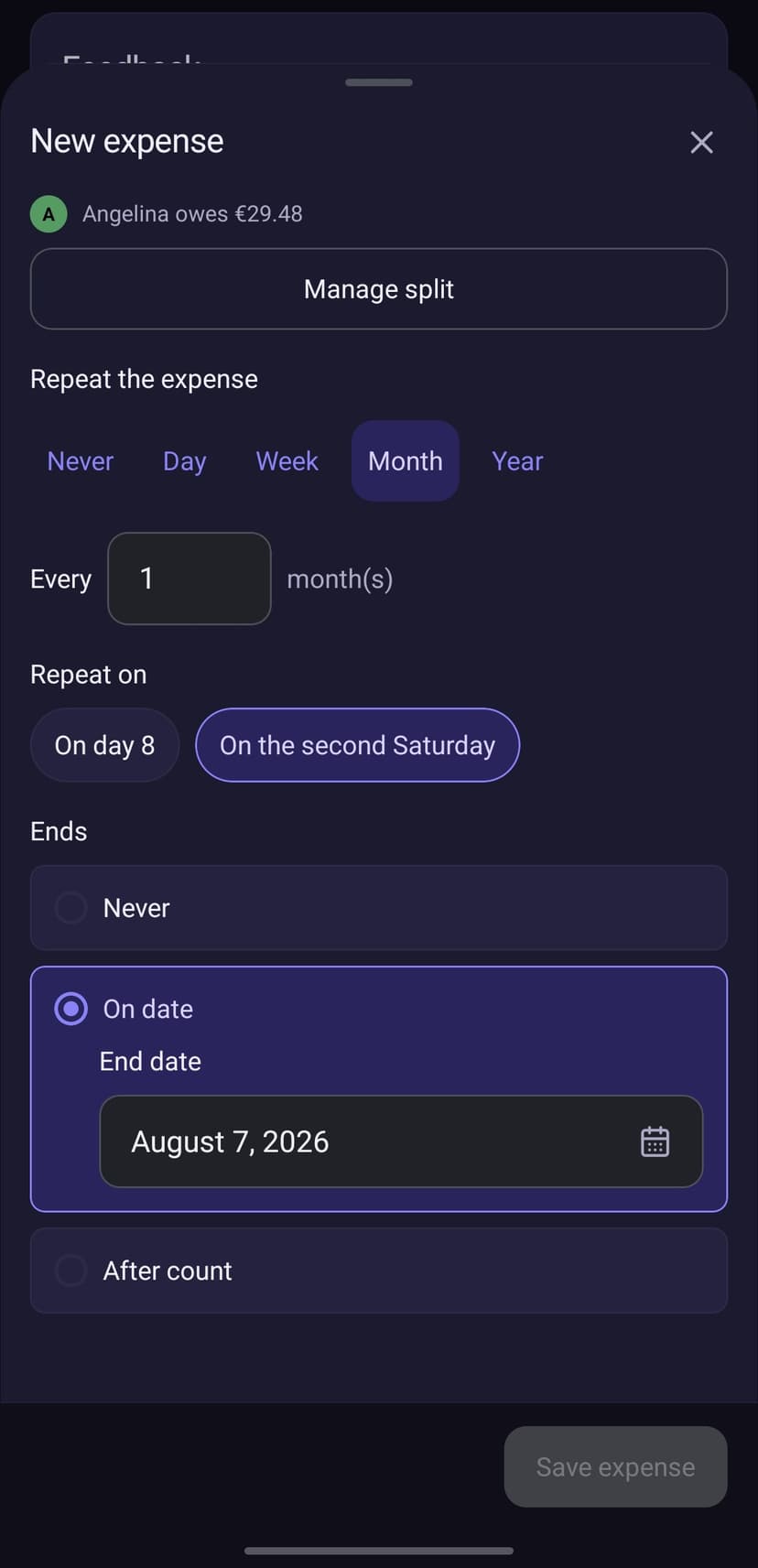
Describing the repetition
Frequency — day, week, month, year — and interval: "Every 2 months".
For a monthly repetition, two ways to target the day:
- On day 15
- On the second Tuesday
The second avoids drift on months with different lengths.
Three possible endings: Never, On a date, After a number of repetitions.
The summary reads plainly: "Every 2 months until 2027-06-30".
Editing: three scopes
| Scope | Effect |
|---|---|
| All repetitions | Rewrites every repetition of the part you are on |
| Only this repetition | An exception, the series is untouched |
| This repetition and later ones | This repetition onward takes the new value; anything before it, if any, is untouched |
Existing personalisations do not survive
Any repetition from this one onward that had already been personalised — a changed amount, a moved date — reverts to the new value instead of keeping its own. Nothing asks for confirmation first.
The two parts stay independent
"This repetition and later ones" divides one series into two independent parts. Later actions apply only to the selected part, never the other. The exception: choosing it on the very first repetition does not divide anything, since there is nothing before it to keep separate. The whole series takes the new value in place instead.
After that change, Boney explains this in the scope chooser, before the actions, for both editing and deletion: "This series has been changed into several parts. Your changes will apply only to this part." "All repetitions in this part" and "This repetition and the following ones in this part" therefore concern only the selected part.
Deletion offers the same three scopes and follows the same rule.
Moving a repetition to another date
Editing a single repetition and changing its date moves it: it disappears from its original date for good and does not create a second entry.
If the new date already has a repetition of its own, both are shown — the move does not replace it, the same way a calendar keeps a moved meeting alongside one already on that day.
The sharing type is locked
On a recurring expense, the sharing intent can no longer be changed: "Type cannot be changed on a recurring expense". To change it, stop the series and create another.
Where to see upcoming occurrences
In the budget detail: they feed the upcoming amount and the end-of-period forecast. They do not mix into what is already spent.