
Add an expense
How do you want to split? — the field that decides whether a balance appears.
An expense always belongs to a budget. One must therefore exist first: otherwise the screen says "Budget required".
The expense stays within that budget. In a shared budget, participants can see the expense, its split, and the resulting balance; they cannot see your personal income.
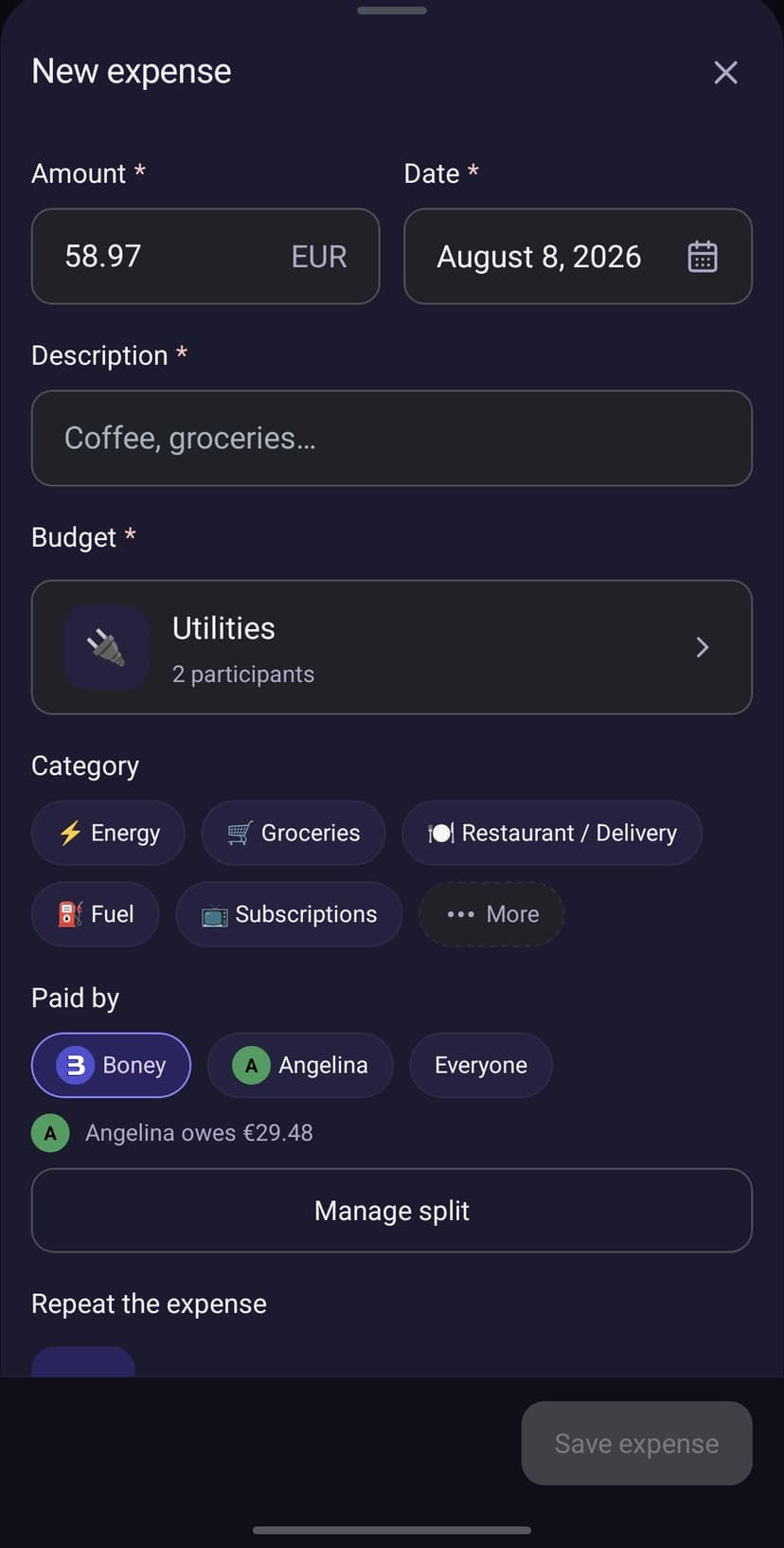
The central field: "How do you want to split?"
On a shared budget, three intents. That choice, and only it, decides the balance.
| Intent | What it means | Balance created |
|---|---|---|
| I'm fronting it | You pay for everyone, the others owe you their share | Yes |
| It's on me | You cover it all, nobody owes you anything | No |
| Each their share | Everyone paid what they owed | No |
The screen states the consequence plainly as you type: "You cover it all", "Everyone paid their share", or "Marie owes €24".
A balance only appears when someone fronted money
"It's on me" and "Each their share" create no debt. That is what separates a gift from an advance — two gestures most apps conflate.
On a personal budget the question does not arise: the field does not appear.
Who paid
When several people could have paid, a second field says which, with an Everyone option.
Total amount or your share
The amount is entered as Total or as Your share. The second mode avoids mental arithmetic when you only know your own contribution.
The other fields
- Description — "Coffee, groceries…"
- Date — in
YYYY-MM-DDformat - Category
- Budget — it supplies the participants and the default split
- Repeat — see Recurring expenses
The split is already filled in
The budget split applies automatically. In the common case there is nothing to do. See Split an expense to depart from it.
Editing or deleting
From the expense itself. Deletion is permanent and goes through a confirmation in the danger zone.
Balances recompute immediately: they follow from the expenses.
Finding an expense
The expenses screen searches on description, budget or payer. It also filters to a single budget from that budget's Expenses tab.