
Create a budget
Personal or shared, with or without an objective — what each field decides.
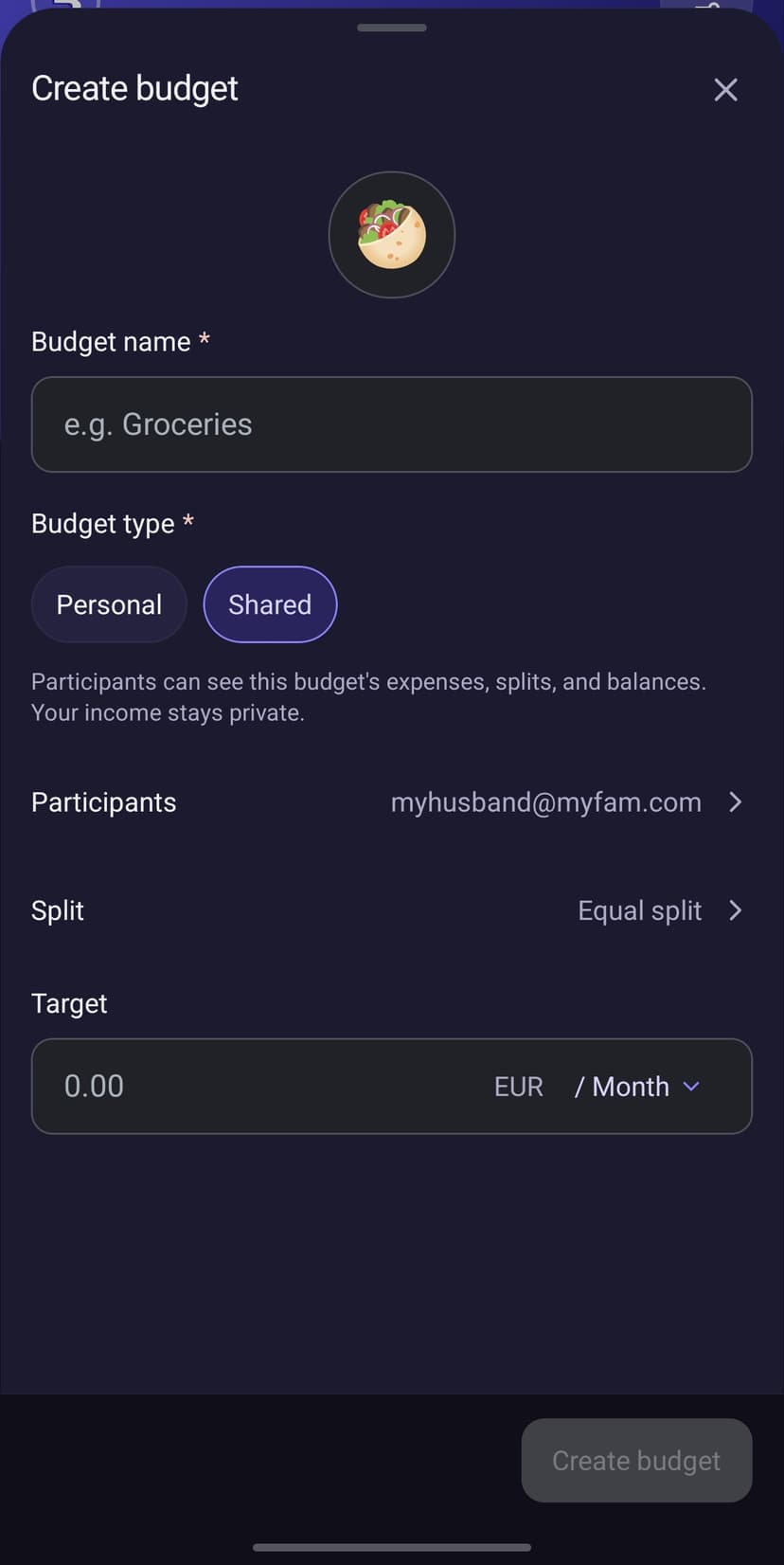
Budget identity
A name — under 50 characters — and an emoji. The name is the only required field.
Personal or shared
| Type | What it changes |
|---|---|
| Personal | For yourself. No balance computed. |
| Shared | Invite other people and split expenses between them. |
A shared budget with no participant behaves like a personal one: it is the arrival of a second person that triggers balance calculation.
What participants can see
Participants can access this budget's expenses, splits, and balances according to their role. A shared budget does not give access to your account or personal income: income stays private and is used only to calculate what is available and how your home view allocates it.
The objective
The field is called Objective, not "limit". It is optional: leave it empty or at zero if this budget has none.
An objective changes two things: the progress shown in the budget detail, and the room this budget takes in the income allocation on the home screen. A budget without one is counted as "no objective" there.
The opening period
Week, Month or Year. This field does not describe a spending frequency: it defines the window the budget is read over by default.
Month and Year follow your budget cycle, not the calendar month.
Inviting at creation
On a shared budget, an invitation can go out at creation time.
One invitation at a time on the free plan
The free plan allows 2 participants per budget: the owner and 1 invitee. The screen says so — "Only one person can be invited for now" — and the limit is enforced server-side.
The budget limit
The free plan allows 3 budgets. Beyond that, creation opens the paywall with the count used: "Limit reached: 3/3 budgets used".
Deleting
Deletion happens from the budget edit screen, in the danger zone, behind an explicit confirmation. The screen warns: deleting a budget is destructive.