
Track a budget
The three detail tabs, and reading the pace.
Three tabs
Summary, Expenses, Debts.
The top banner gives the current cycle, the type — Personal or Shared — and the state of the period.
The period state
| State | Display |
|---|---|
| On track | 62% · on track |
| Almost full | 88% · almost full |
| Over budget | +12% · over budget |
Without an objective, the detail says so — "No objective set for this budget" — and the threshold reading disappears. Everything else works.
The pace
Boney compares two progressions: the budget's and time's. "45% spent · 60% of the time" becomes Ahead or On track.
That is the useful reading mid-period: a budget at 45% after 60% of the time is not a budget in danger.
Spent, upcoming, forecast
Three distinct figures:
- Already spent — what went out
- Upcoming — what is committed in the period, future expenses and recurring occurrences
- Forecast — the total expected at period end
Do not confuse spent with forecast: a budget can be "on track" today and "over budget" in forecast, because of what is already committed later in the period: an expense dated in the future, just as much as an occurrence of a recurring series.
The Debts tab
The balances this budget generated, the total, and the detail of settlements already made. If there is nothing: "No debt".
Per-participant split
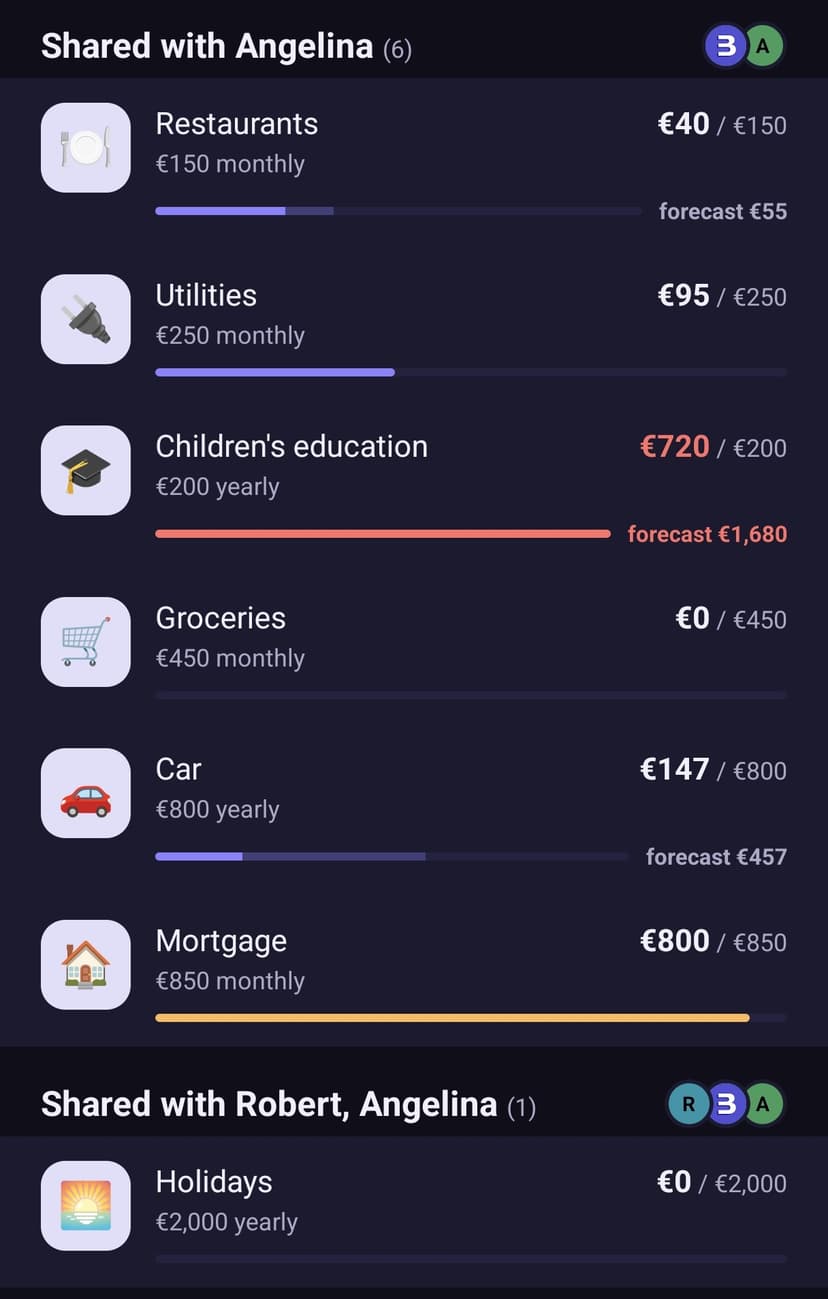
On a shared budget, the summary shows what each person spent, and the share of spent income that falls to you.
Actions
From the detail: add an expense, invite a participant, manage participants, set the split, edit or delete the budget.